Crossplay server sync tech: Why robust encryption is key
"The foundation of modern interactive experiences rests on the ability to keep disparate players in a single, cohesive reality through precise technical synchronization."
Effective crossplay server sync tech ensures that players on different hardware can interact in a shared digital space without noticeable delays or visual inconsistencies.
This process involves managing data transmission, reconciling latency, and maintaining a single source of truth for the game state.
Key takeaways include the importance of low-latency server communication, the role of client-side prediction, and the necessity of robust encryption to prevent unauthorized manipulation of the game environment.
How does crossplay server sync tech work?

At midnight in the dim studio, the developer taps their fingers nervously against the desk while watching the crossplay data stream across the glowing monitor.
A developer sits at a workstation, monitoring a stream of incoming network packets that represent player movements and combat actions.
To maintain a seamless experience, the server acts as the central brain, processing every input from various devices to ensure everyone sees the same event at roughly the same time.
Game data synchronization requires the server to receive inputs from multiple platforms and resolve them according to a master timeline.
Because different devices have varying hardware capabilities, the server must standardize the data it receives to prevent one player's lag from ruining the experience for others.
Realtime crossplay sync relies on this constant exchange of information to ensure that a shot fired on a console is registered accurately against a player on a PC.
The primary challenge is managing the delay caused by physical distance and network congestion. If the server-side logic is too slow, players will experience "rubber-banding," where their characters snap back to previous positions. If it is too fast, it may ignore legitimate movements.
Efficiently managing these data packets is the core of maintaining a stable environment for all participants.
- The client sends local state updates to the central server.
- The server validates the data and resolves conflicts between players.
- The server broadcasts the authoritative state back to all connected clients.
What are the primary challenges in data sync?
A technician watches a monitor where a character seems to teleport across a room due to a sudden spike in network latency. This visual glitch is a common symptom of synchronization failures, where the client's local view deviates from the server's authoritative state.

One major obstacle is the inherent difference in network stability between wired and wireless connections. While a desktop might have a stable link, a mobile device might face sudden drops in signal, requiring the server to handle packet loss gracefully.
Server tech for crossplay must account for these fluctuations to prevent players from being disconnected during critical gameplay moments.
Another difficulty involves reconciling different frame rates and input polling rates across various hardware. If one device processes 120 frames per second and another processes only 30, the server must ensure that the game logic remains fair.
This requires sophisticated algorithms to interpolate or extrapolate movement so that the game remains playable despite hardware disparities.
In this sequence, the second challenge is the most complex.
How is server tech for crossplay implemented?
The programmer taps a pen against the desk in the quiet office, staring at the flickering screen as they implement the new crossplay server logic.
An engineer writes lines of code designed to prioritize certain types of data packets, such as player position over cosmetic animations, to save bandwidth. This prioritization ensures that the most critical gameplay information reaches the server first, maintaining the integrity of the match.
Implementing these systems usually involves three distinct layers of communication: 1. Client-side prediction: The local device simulates the player's movement immediately to provide instant feedback, while waiting for the server to confirm the action. 2.
Server reconciliation: When the server receives the movement data, it checks it against the game rules and sends a correction back to the client if the prediction was wrong. 3.

State synchronization: The server broadcasts the updated, "true" state of the game to all connected clients to keep everyone aligned.
I remember watching a test build where we adjusted the reconciliation window to see how it affected the feel of the movement. It became clear that finding the right balance between responsiveness and accuracy is a constant tug-of-war in development.
A final check is always performed to ensure that the latency compensation does not give an unfair advantage to players with extremely low-ping connections.
How can developers handle latency in crossplay?
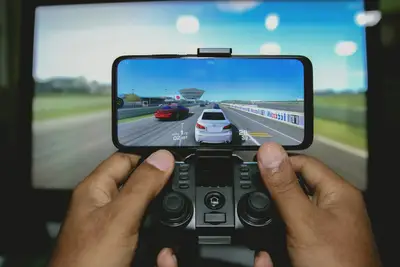
A player grips a controller, waiting for a character to react to a button press, hoping the netcode handles the delay smoothly. When latency is high, the gap between an action and its visual result can break the immersion and the competitive integrity of the game.
Developers use techniques like "lag compensation" to help players with higher latency. The server keeps a short history of player positions so that when a high-latency player claims they hit a target, the server can "look back in time" to see if the shot was valid at the moment it was fired.
This prevents players from having to "lead" their shots excessively to account for lag.
However, these techniques can lead to "getting shot behind a wall" scenarios. This happens when a player moves to safety on their screen, but the server—processing an older state—determines the player was still in the line of fire.
Balancing these experiences is one of the most difficult tasks in modern game networking.
What are the limitations of current synchronization methods?
A programmer reviews a log of missed packets, noting that certain hardware configurations are still failing to stay synchronized during heavy combat. This reality highlights that no matter how advanced the software, physical limitations of the internet still exist.

A significant limitation is that synchronization cannot fully overcome extreme physical distance or severe hardware bottlenecks. If a player's connection is too slow to transmit basic movement data, no amount of server-side logic can make the gameplay smooth.
Furthermore, heavy computational tasks on low-end devices can cause processing delays that mimic network lag, creating a "desync" that is difficult to resolve through software alone.
| Feature | Client-Side Prediction | Server Reconciliation |
|---|---|---|
| Primary Goal | Instant responsiveness | Maintaining the "true" game state |
| Main Risk | Visual "rubber-banding" | High CPU/Network load |
The effectiveness of these methods is bounded by the quality of the underlying internet infrastructure and the processing power of the end-user's device.
Related







Comments 0